
Every once in a while an album lands in front of me that reminds me why I started listening to music in the first place.
Not for the algorithms.
Not for the perfectly engineered production.
Not because somebody told me I was supposed to like it.
But because a collection of songs can somehow find its way underneath the skin and make you feel like you have been invited into somebody else’s world for a little while.
That is ‘Anywhere But Here’.
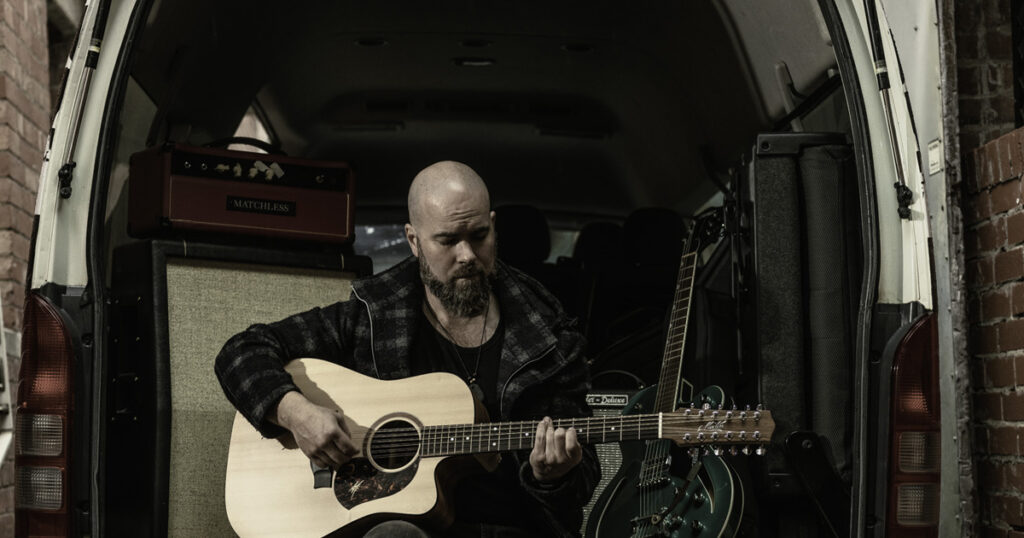
Bully Hay is a Tasmanian singer-songwriter and multi-instrumentalist whose music lives somewhere between Australian rock, alternative, folk-rock, and whatever else happens to wander into the room when he starts writing. After falling completely in love with his previous album, ‘Black Dogs and Songbirds’, which became my personal Album of the Year in 2024, I was more than curious to hear what he would do next.
I was also slightly nervous.
Because when an artist gives you an album that means something to you, the next one comes with expectations.
Thankfully, Bully Hay apparently has no interest in making my life easy.
He made another bloody brilliant album.
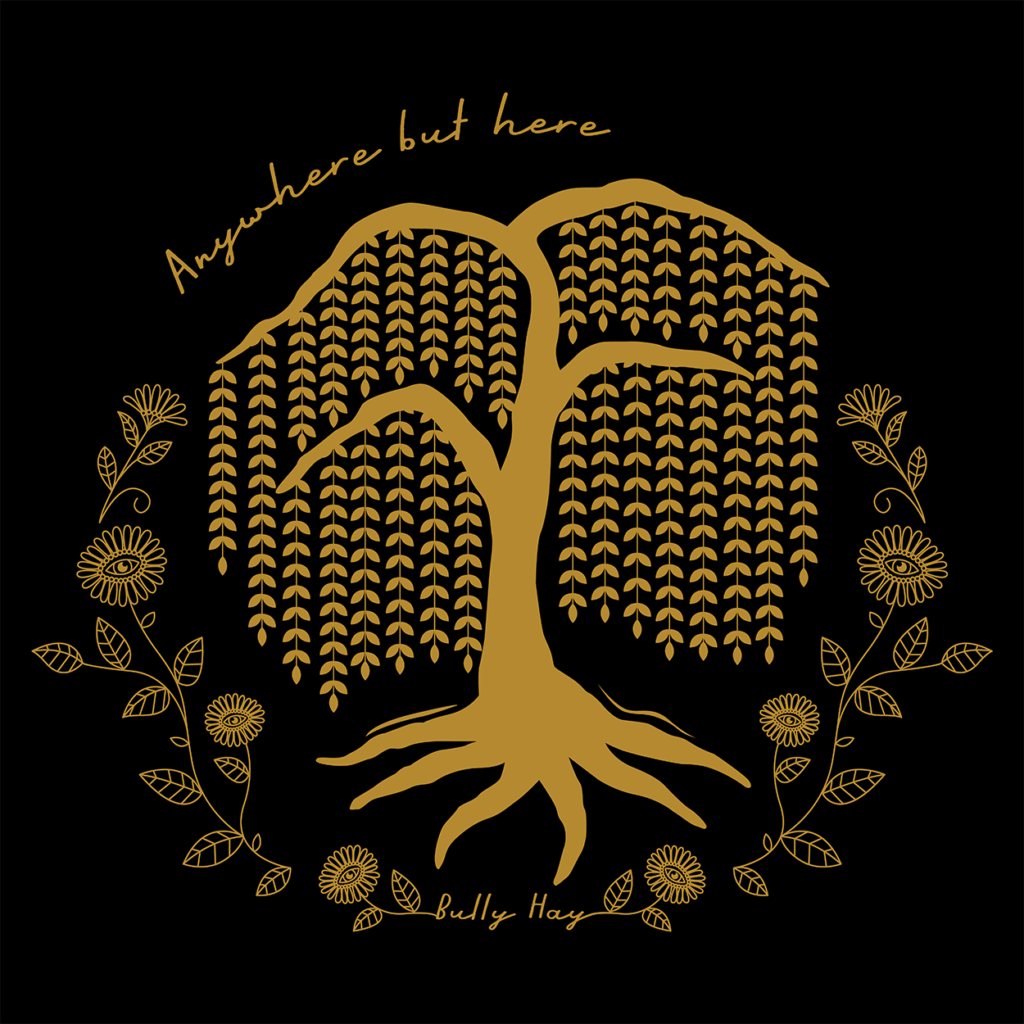
What struck me first about ‘Anywhere But Here’ is how much ground Bully Hay covers without ever sounding like he is trying to prove how versatile he can be. The songs move through different moods and textures naturally, almost as though the album is following the emotional path of the person who created it rather than a predetermined musical formula.
And that makes sense when you consider where these songs came from.
This is an album born out of some incredibly difficult periods in Bully Hay’s life. You can hear that history in the cracks. You can hear it in the quieter moments, in the darker arrangements, in the words that feel like they were pulled from somewhere much deeper than the surface.
But there is also life here.
A lot of it.
‘Lovers Get High’ kicks the door open and immediately tells us that Bully Hay isn’t simply picking up where he left off. There is a confidence in the song that feels like an artist stretching his legs and realizing just how far he can run. It is melodic, immediate, and ridiculously easy to get stuck in your head.
I know this because I left the house for a coffee and found myself still humming it.
That is when you know a song has done its job.
‘If You Can’t Forgive Me, Forgive Yourself’ takes that momentum and runs with it. The drumming deserves serious attention here. It has that propulsive quality that makes you want to drive somewhere without necessarily caring where you’re going. I kept thinking about those classic road-trip songs—the ones that somehow make an ordinary stretch of highway feel like the opening scene of a movie.

There are recognizable pieces of musical history tucked into this record, but Bully Hay never disappears behind his influences. You might hear a little Tom Petty here, a touch of The Cure there, perhaps some of The Ramones or Springsteen, but eventually that wonderfully weathered Bully Hay vocal arrives and reminds you exactly whose record you’re listening to.
Then he does something completely different.
‘Running Up That Hill (A Deal With God)’ could have been an unnecessary inclusion. Instead, Bully Hay takes Kate Bush’s already emotionally loaded song and turns it into something deeply personal. His acoustic guitar work is gorgeous, and the sparseness of the arrangement initially gives the track an almost private quality.
Then the drums and bass enter.
And suddenly the emotional ceiling gets blown off.
It is a beautiful example of why reinterpretation can be so much more interesting than imitation. Bully Hay isn’t trying to become Kate Bush. He is finding the part of the song that speaks to him and allowing us to hear it through his own emotional vocabulary.
And then comes ‘Trinkets & Coal’.
This one hurts.
In the best possible way.
Everything feels closer here. The arrangement breathes differently. The melancholy is allowed to linger. His voice carries the weight while the guitars sit underneath it, creating an atmosphere that feels almost too intimate to be listening to through speakers.
This is the sort of song that makes you stop whatever else you’re doing.
I found myself thinking of Dallas Green and ‘Sometimes’ while listening to it, not because the two artists sound identical, but because they share that ability to make vulnerability feel incredibly beautiful rather than uncomfortable.
Then, just when the album has successfully made me emotionally fragile, Bully Hay throws ‘Another Lost Soldier’ at me.
Thank you, Bully.
This song is an absolute earworm.
There is a darkness underneath it, but the track carries itself with such an infectious energy that it becomes impossible not to get pulled along. I hear some of The Killers in the way the song balances darkness with momentum, and that chorus is precisely the sort of thing that makes you start imagining where a song could go if it found the right audience.
If I were choosing a track to introduce somebody to Bully Hay, this would be very high on my list.
Then comes the acoustic version of ‘Wash Off The World’, and this is where I was reminded of something important: sometimes taking things away gives you more.
The original song already holds a special place for me, but hearing it stripped back changes the relationship between the listener and the material. Suddenly there is nowhere for the emotion to hide. The vocal has more responsibility. The words have more space. The song becomes less about the production surrounding it and more about the person standing behind it.
And Bully Hay absolutely owns that space.
‘We Can Drive’ takes us somewhere considerably darker. The opening feels almost hymn-like before the song begins descending into heavier territory. There are moments where I could easily imagine Alice In Chains being somewhere in the room, but again, this isn’t imitation. Bully Hay borrows from the language of darkness and speaks it in his own accent.
The chorus is magnificent.
But it is the closing stretch of the song that really got me. There is something almost cinematic happening there, like watching the final scenes of a film when you suddenly realize just how much the characters have been through.
Then the rain begins.
‘I Can Be Your Lover’ opens with that wonderfully strange combination of rainfall and what sounds like a drone instrument before the acoustic guitar enters. From there, the song takes on an almost maritime quality.
Maybe I’m projecting here, but I kept thinking about the ocean.
Considering Bully Hay comes from Tasmania, perhaps that shouldn’t surprise me. There is something about the song that feels weathered by saltwater and distance. It feels like a confession made somewhere far away from the rest of the world.
‘Talk Me Off The Edge’ is another fascinating turn. The guitar work gives the song a sense of movement that feels almost hypnotic, and there is a worldly quality to the arrangement that kept pulling me deeper into it. I genuinely lost track of time while listening.
That doesn’t happen often.
And then, before I’m ready for it, we reach the final song.
‘Here It Comes Again’.
I could have happily listened to another twenty tracks at this point, but perhaps that would be greedy.
Ten was enough.
More than enough, actually.
Because this final song feels like the appropriate place to leave us. It takes its time. The guitar carries an almost vocal quality of its own, and Bully Hay’s performance feels stripped down to the essentials. There is no need for theatrics. No need to force the emotion.
He simply lets the song exist.

And perhaps that is the greatest lesson hidden inside ‘Anywhere But Here’.
You don’t have to scream to be heard.
You don’t have to make everything bigger.
Sometimes the most devastating thing an artist can do is simply tell the truth.
Bully Hay does that repeatedly throughout this album.
He writes about pain without turning it into spectacle. He writes about complicated emotions without needing to neatly resolve them. He allows sadness, hope, anger, desire, uncertainty, and reflection to coexist.
That’s life.
And perhaps that is why this album feels so real.
I also have to give credit where credit is due for the people behind the sound. ‘Anywhere But Here’ was recorded, produced, and engineered by Jonathon Coleman—Bully Hay himself—and his close friend and drummer Andrew Castles, with mixing handled by Christian Pyle and Tony Sayer. That intimate understanding between the people creating the record is apparent in the finished product.
This doesn’t sound like an album assembled by committee.
It sounds like musicians making music together.
And in 2026, that is worth celebrating.
We are living through a time when technology can imitate almost anything. Music can be generated, polished, manipulated, reconstructed, and packaged within an inch of its life. Yet there remains an undeniable difference between something that has been manufactured to sound emotional and something created by a human being who has actually lived through the emotions he is singing about.
‘Anywhere But Here’ belongs to the latter.
This album has scars.
And I mean that as the highest compliment possible.
It feels lived in.
It feels earned.
It feels like somebody went through the fire, came out the other side, and decided that instead of pretending everything was fine, he was going to make an album about what it actually felt like.
That is why I keep coming back to it.
And that is why Bully Hay continues to be one of those artists I genuinely believe more people need to discover.
I loved ‘Black Dogs and Songbirds’.
I didn’t think he could top it.
I’m beginning to think he may have.
Is ‘Anywhere But Here’ my next Album of the Year?
Ask me again when the year is over.

But I’ll tell you this right now:
It’s going to take one hell of an album to knock it out of contention.
Put this album on when you have the time to actually listen to it. Don’t put it on as background noise while you’re answering emails. Don’t shuffle it. Don’t skip around.
Start at the beginning.
Let it take you where it wants to go.
And when ‘Here It Comes Again’ finally fades away, you’ll probably understand exactly why I’m sitting here wondering how an artist from Tasmania managed to make me feel like he had been writing these songs specifically for me.
That’s the magic of music.
And Bully Hay has it in spades.
‘Anywhere But Here’ isn’t just an album I enjoyed.
It’s an album I’m grateful I heard.